The 24th Pacific Science Congress successfully held in Shantou City of China
December 2, 2025
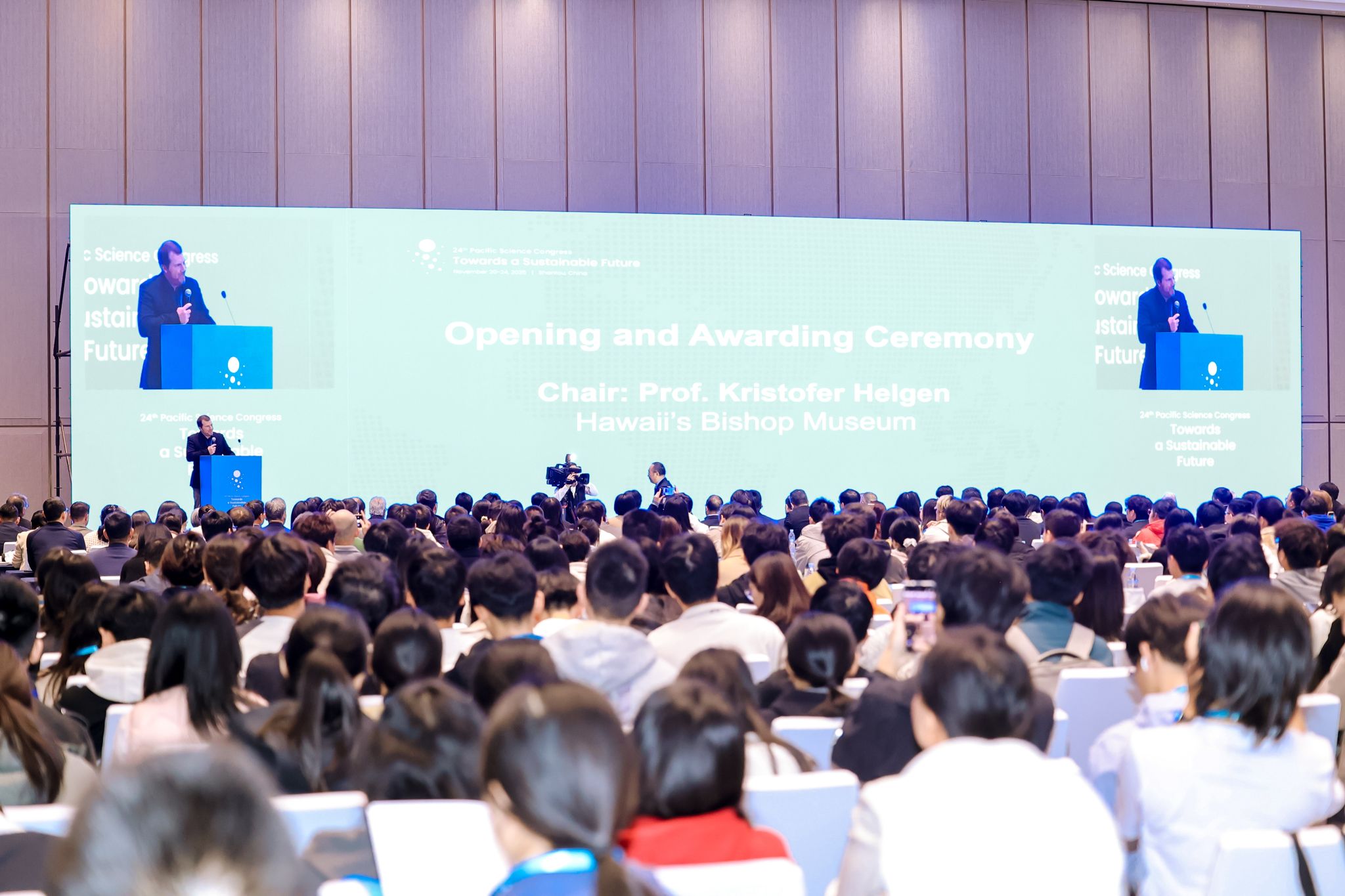
The 24th Pacific Science Congress, themed "Towards a Sustainable Future," was successfully held from November 21 to 24 in Shantou City, Guangdong Province of China. Organized by the Pacific Science Association, the Congress was co-hosted by Shantou University, Xiamen University, and the Chinese Committee for Pacific Science Association, with collaboration from the Guangdong Sino-Israel Institute of Technology, and the Shantou Association for Science and Technology. The event attracted some 800 participants from over 150 academic institutions and organizations across 18 countries and regions, featuring 250 high-level academic presentations led by 15 Chinese and international academicians.
Professor Yonglong Lu, President of the Pacific Science Association, Fellow of The World Academy of Sciences, and Chair Professor of Xiamen University, stated in his opening address that for over a century since its establishment, the Pacific Science Association has been consistently committed to promoting science development in the Asia-Pacific region and globally. To address the major challenges currently facing humanity, such as global climate change, ecological degradation, and environmental pollution, this Congress brings together top global scientists. Through in-depth interdisciplinary discussions, it systematically explores pathways to achieve global sustainable development goals, further promoting international scientific cooperation and common development.
Other leaders also delivered addresses, including Qin Jiuyi of the International Science and Technology Exchange Center of the China Association for Science and Technology, Cheng Hongbo of the Guangdong Association for Science and Technology, Wen Zhanbin of Shantou City, and Tang Rui of Shantou University. They respectively extended warm congratulations on behalf of their organizations on the convening of the Congress, and expressed their wishes for further collaborations. The opening ceremony was presided over by Professor Kristofer M. Helgen, Director of the Bishop Museum in the United States.
A grand awards presentation was held at the opening ceremony. Professor Jurgenne H. Primavera of the Zoological Society of London, Fellow of The World Academy of Sciences (TWAS), received the Shinkishi Hatai Medal in Marine Biology for her outstanding contributions to mangrove conservation. Professor Scott V. Edwards of Harvard University, member of the National Academy of Sciences (USA), was awarded the Herbert E. Gregory Medal for his great contributions to biodiversity science. Professor Congbin Fu of Nanjing University, an Academician of the Chinese Academy of Sciences, was conferred the title of "Honorary Life Fellow of the Pacific Science Association" for his exceptional contributions to the development of the Pacific Science Association and international academic exchange and cooperation. Professor Yonglong Lu, President of the Pacific Science Association, presented the trophies and certificates to the respective awardees.
Professor Michael T. Clegg, Member of the National Academy of Sciences (USA); Professor Fu Bojie, Academician of the Chinese Academy of Sciences; Professor Scott V. Edwards, Member of the National Academy of Sciences (USA); Professor Xia Jun, Academician of the Chinese Academy of Sciences; Professor John P. Giesy, Fellow of the Royal Society of Canada; Professor Shahid Naeem from Columbia University (USA); Professor Yonglong Lu, Fellow of The World Academy of Sciences; Professor Alessandro Chiarucci, Member of Academia Europaea; Professor Kristofer M. Helgen from the Bishop Museum (USA); and Professor Guan Yi from Shantou University, Foreign Member of the UK Royal Society of Physicians, delivered outstanding keynote addresses centered around the congress theme.
The Congress was also attended by leading domestic and international experts and scholars, including Academicians of the Chinese Academy of Sciences, Profs Congbin Fu, Shu Tao, and Keping Ma; Professor Pavel V. Krestov, Corresponding Member of the Russian Academy of Sciences; Professor Kim Sanggu, Member of the Korean Academy of Science and Technology; and Professor Jurgenne H. Primavera, Fellow of The World Academy of Sciences.
The Congress had 11parallel sessions, covering the world's most pressing scientific frontiers, including “Climate and the Earth System”, “Extreme Weather and Climate Events and Their Impacts”, “Biodiversity and Ecosystems”, “Emerging Contaminants and Their Environmental and Health Effects”, “Urban Metabolism and Sustainability Transition”, “Environmental Health and Human Well-being”, “AI-based Brain Science and Innovation”, “Social-ecological Systems and the Water-Energy-Food Nexus”, “Ecological Sensitivity and Sustainability”, “Polar Environmental Changes and Their Impacts”, as well as “Coastal and Marine Health”. These topics fully demonstrate the interdisciplinary nature of the Congress, spanning from climate change to artificial intelligence, from the polar regions to the oceans, and from theory to application, providing participants with a broad platform for exchange.